
The Authoritative Edge: Why Licensed Brokers and Title Intelligence Elevate Broker's Price Opinions
In the dynamic landscape of real estate, accurate property valuation is paramount. While appraisals serve as the gold standard for many transactions, Broker's Price Opinions (BPOs) offer a flexible, cost-effective alternative, particularly in situations demanding speed and broker-level market insight. However, the true authority and utility of a BPO are intrinsically linked to the qualifications of its creator and the depth of its underlying research, especially when integrated with comprehensive title intelligence.
The Indispensable Role of the Licensed Real Estate Broker
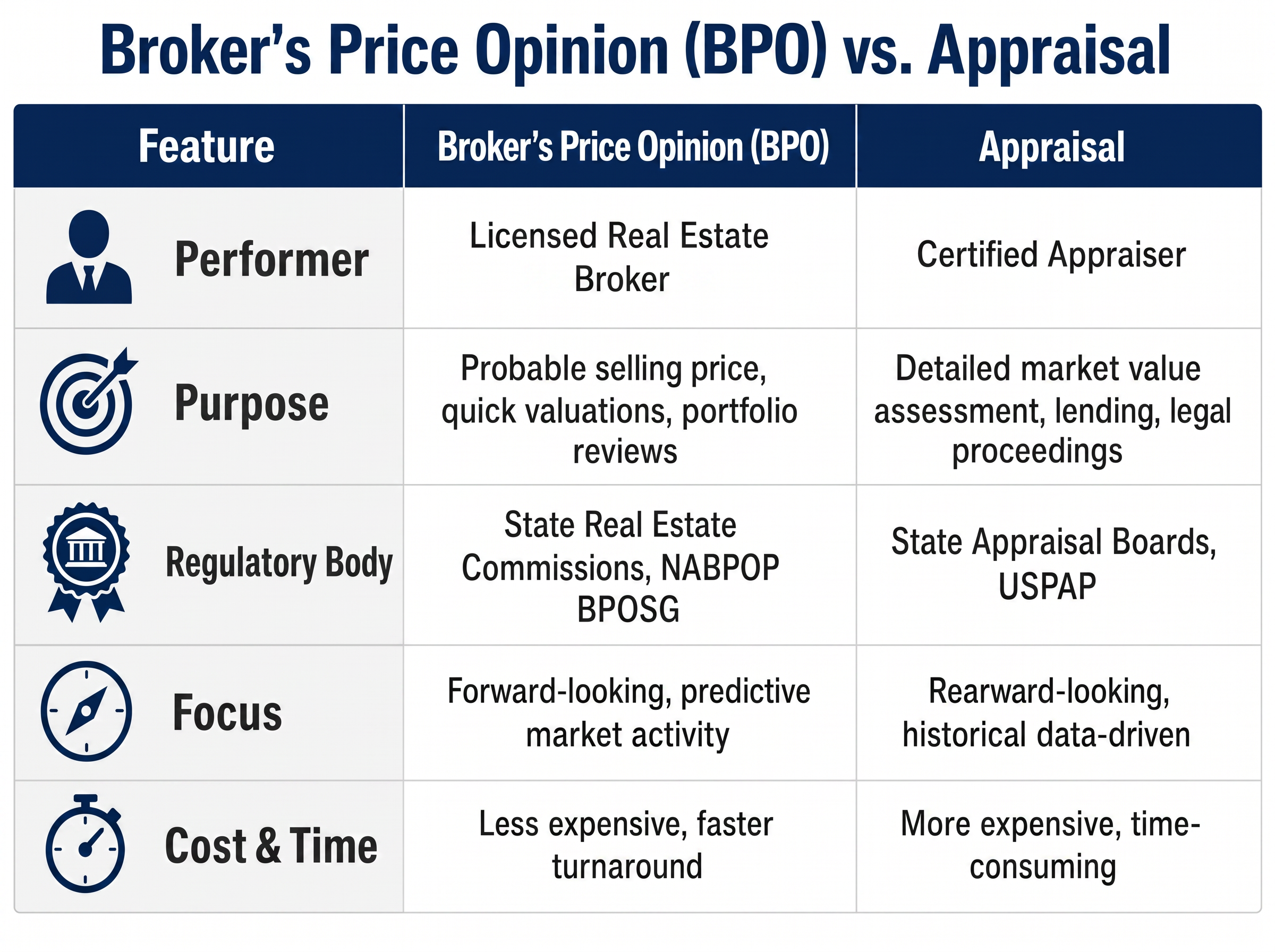
A Broker's Price Opinion, by its very definition, is an estimate of a property's probable selling price, prepared by a licensed real estate broker. This requirement is not arbitrary; it stems from the unique position and expertise that licensed real estate professionals hold within the market:
Market Expertise: Licensed brokers are immersed in local real estate markets daily. They possess firsthand knowledge of current trends, neighborhood nuances, buyer demand, and recent comparable sales that may not yet be reflected in public records or accessible to appraisers .
Transactional Experience: Unlike appraisers who primarily assess historical data, brokers are actively involved in the negotiation and sale of properties. This grants them a forward-looking perspective, understanding what buyers are willing to pay and what sellers are willing to accept in the current market .
Ethical and Regulatory Framework: Real estate licensees operate under state-specific licensing laws and ethical guidelines. These regulations ensure a level of professionalism, accountability, and adherence to standards in their valuation activities, including BPOs.
Legal Authority and State-Specific Regulations: The Foundation of a Broker's Price Opinion
The authority for a licensed real estate broker to perform a BPO is primarily derived from state real estate licensing laws and regulations. These statutes explicitly grant brokers the right to provide opinions of value within the ordinary course of their business, distinct from the more stringent requirements for certified appraisals. For instance, in states like California, a BPO must be conducted by a licensed broker as part of their regular business activities. Similarly, Florida mandates that brokers performing BPOs maintain their licenses in good standing and adhere to the Florida Real Estate Commission's (FREC) regulations.
This legal framework, coupled with the broker's daily immersion in local market dynamics, forms the bedrock of their authority. While BPOs are not formal appraisals governed by the Uniform Standards of Professional Appraisal Practice (USPAP), the National Association of BPO Professionals (NABPOP) provides comprehensive Broker Price Opinion Standards and Guidelines (BPOSG). These guidelines establish a framework for ethical conduct, competency, and best practices, ensuring a consistent and professional approach to BPO preparation, even where state laws may be less prescriptive. The BPOSG emphasizes that its standards are "absolute and must be adhered to without exception," reinforcing the commitment to quality and reliability in BPO practice.
The Enhanced Authority of a Title-Based Broker's Price Opinion: Beyond Market Comparables
While a traditional BPO primarily relies on comparable sales and current market conditions, a title-based BPO elevates this analysis by integrating a critical layer of Legal Intelligence through a thorough examination of the property's title history. This approach significantly enhances the authority and reliability of the valuation, particularly for investors, lenders, and legal professionals navigating distressed properties, complex transactions, or judicial proceedings.
By proactively investigating the title, a broker can uncover potential clouds on title, undisclosed liens, critical encumbrances, and fundamental ownership issues that could drastically impact a property's marketability, financeability, and ultimately, its actual value. This comprehensive approach aligns with The Title Detective Mindset, which prioritizes verifying ownership, legal authority, and potential defects before any financial underwriting. This methodology prevents wasted time and resources on deals that are legally unfeasible or carry unforeseen liabilities.
Crucially, to perform a truly authoritative title-based BPO, the broker must possess significant, verified experience dealing with and resolving complex title issues. This is not merely about identifying problems but understanding their practical implications and potential solutions. Furthermore, holding a title examiner license or equivalent certification is paramount, as it provides the specialized legal knowledge and authority to interpret intricate title documents and present these findings with the utmost good faith and credibility to any person reviewing the report. This specialized expertise ensures that the BPO's conclusions are not just market-driven but also legally sound and practically actionable.
Additional Criteria for a Title-Based BPO:
Beyond the standard market analysis, a title-based BPO incorporates specific criteria to provide a more robust and legally informed valuation:
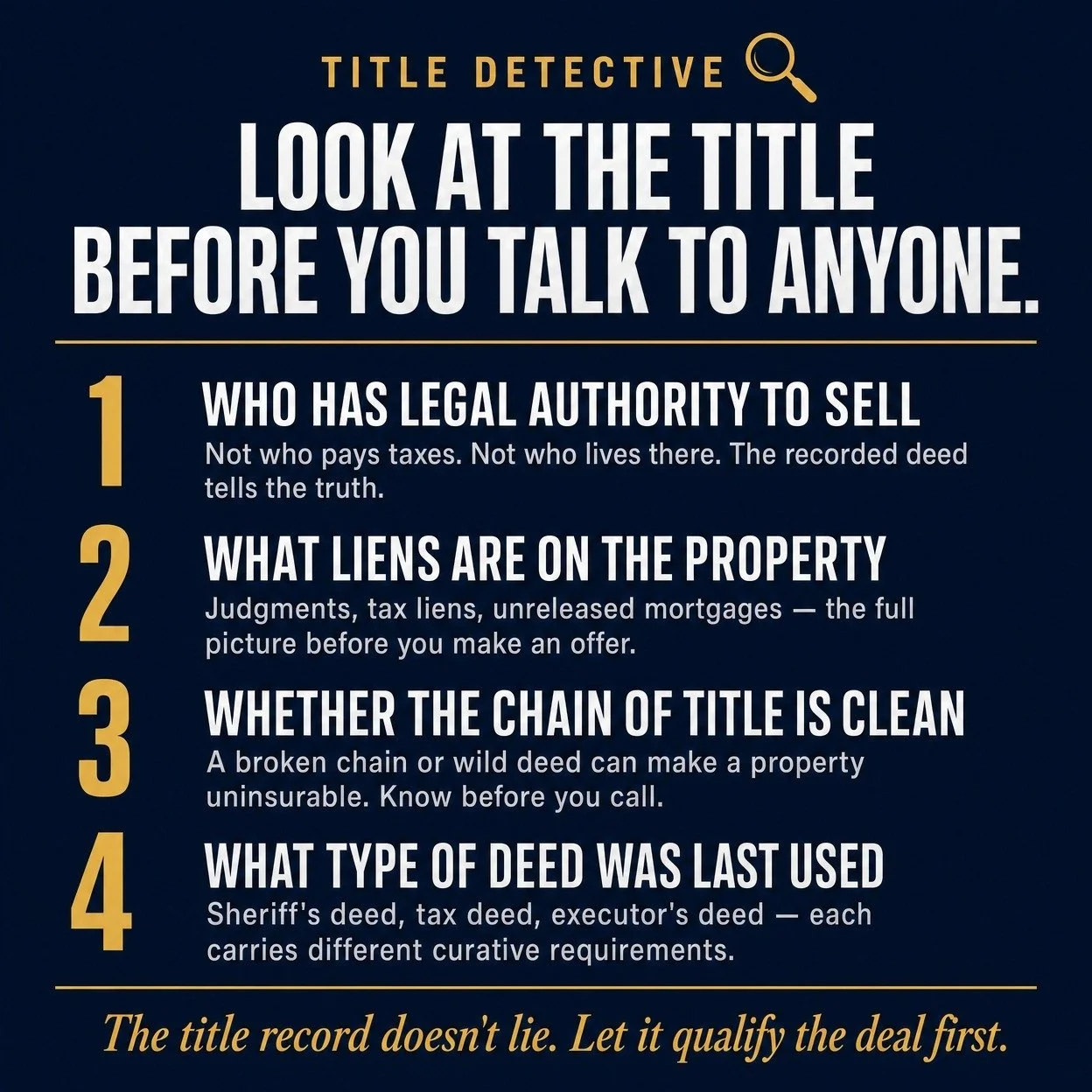
Unbroken Chain of Title Verification: Ensuring a clear and continuous record of ownership transfers, identifying any missing links or irregularities that could challenge legal ownership.
Lien Priority Analysis: A detailed assessment of all recorded liens (e.g., mortgages, judgments, tax liens, HOA liens) to determine their legal precedence and potential impact on the property's equity and market value. This includes understanding "super-priority" liens like property taxes that can supersede even first mortgages.
Legal Authority of Grantor Confirmation: Verifying that the current owner(s) or their representatives (e.g., trustees, executors, LLC managers) possess the undisputed legal right to convey the property. This involves reviewing trust documents, probate orders, corporate resolutions, or powers of attorney.
Impact of Encumbrances and Restrictions: Analyzing how easements, restrictive covenants, or other recorded encumbrances affect the property's use, development potential, and market appeal. For example, an unreleased utility easement might restrict future construction, thereby reducing value.
Identification of Title Defects: Proactively identifying issues such as wild deeds, forged signatures, improper notarizations, or unresolved probate matters that could render a title uninsurable or subject to legal challenge.
These additional layers of due diligence transform the BPO from a market snapshot into a comprehensive legal and financial risk assessment, providing a far more accurate and defensible opinion of value.
Documentation: The Cornerstone of an Authoritative Title-Based BPO
The authority of a title-based BPO is not merely in the broker's opinion but in the robust documentation that supports it. This documentation provides a clear, defensible basis for the valuation, highlighting both the market value and any factors that might adjust that value due to title issues. Key documentation includes:
Chain of Title Analysis: A detailed review of the property's ownership history, tracing transfers back to a statutory period or original owner. This identifies any breaks, gaps, or irregularities that could cloud title. Documents include recorded deeds (warranty, quitclaim, special purpose) and their proper execution and notarization.
Lien and Encumbrance Searches: Comprehensive searches for all recorded liens (mortgage, judgment, tax, mechanic's, HOA) and encumbrances (easements, covenants, restrictions). The BPO should document the type, amount, recording date, and priority of each, as these directly affect the property's net value and market appeal.
Vesting and Authority Verification: Examination of the current deed to confirm how title is held (vesting) and to verify that the party intending to sell has the legal authority to do so. This is critical in cases involving trusts, LLCs, probate, or divorce, where proper authorization documents (e.g., trust agreements, operating agreements, probate orders) must be in place.
Legal Description Verification: Confirmation that the property's legal description is accurate and consistent across all relevant documents, preventing issues like wild deeds or boundary disputes.
Public Records Review: Beyond recorded documents, a title-based BPO may incorporate findings from assessor's records, tax records, and court records (e.g., for probate, bankruptcy, or divorce proceedings) to provide a holistic view of the property's legal standing and any associated financial pressures.
By meticulously documenting these title-related findings, a title-based BPO transcends a mere market estimate. It becomes a powerful tool that not only provides a probable selling price but also identifies and quantifies the impact of legal and financial encumbrances, offering a more realistic and actionable valuation for informed decision-making.
The "Good Faith" Advantage: Why Title Intelligence Builds Trust
For judges, lenders, investors, and other stakeholders, the inclusion of comprehensive title intelligence in a BPO report significantly enhances its credibility and establishes a foundation of "good faith" in the final valuation. This trust is built upon several key factors:
Comprehensive Risk Disclosure: A title-based BPO demonstrates that the broker has not merely estimated a market price but has also diligently investigated and disclosed all known legal and financial risks associated with the property. This transparency is crucial for any party relying on the valuation for critical decisions, especially in legal contexts where due diligence is paramount .
Alignment with Legal Realities: The valuation presented in a title-based BPO is grounded in the property's actual legal status, not just its physical characteristics or market comparables. A judge, for instance, is far more likely to accept a valuation that accounts for a significant unreleased mortgage, a complex probate situation, or a restrictive easement, as it reflects the true encumbered value of the asset . Ignoring such critical title defects, or failing to accurately assess their impact on marketability, could lead to a valuation being deemed unreliable or even lacking in good faith. Title issues directly impact marketability by:
Restricting Buyer Pool: Many buyers, especially those requiring financing, will be deterred by properties with clouded titles, significantly shrinking the potential market.
Increasing Transaction Costs: Resolving title defects often involves legal fees, quiet title actions, or the purchase of expensive title insurance riders, all of which reduce the net proceeds for the seller and increase the overall cost for the buyer.
Extending Closing Timelines: Complex title issues can delay or even derail transactions, leading to lost opportunities and increased carrying costs for all parties.
Reducing Property Value: The uncertainty and cost associated with resolving title defects inherently diminish a property's perceived and actual market value, often leading to discounted sales prices.
By explicitly addressing these impacts, a title-based BPO provides a realistic valuation that accounts for the full spectrum of challenges a property may present.
Demonstrated Competency and Diligence: By performing a detailed title examination, backed by verified experience in resolving title issues and holding a title examiner license, the broker showcases an unparalleled level of competency and professional diligence. This proactive approach, adhering to both market valuation principles and the investigative rigor of title analysis, signals to all parties—especially judges and legal professionals—that the valuation is thorough, legally sound, and well-researched, minimizing the potential for unforeseen liabilities . The specialized knowledge of a licensed title examiner ensures that the interpretation of complex legal documents is accurate and reliable, lending significant weight to the BPO's findings.
Defensibility in Disputes: In cases of litigation, bankruptcy, or foreclosure, a title-based BPO provides a robust, documented basis for the property's value. The detailed records of liens, ownership, and encumbrances offer clear evidence to support the valuation, making it more defensible against challenges and contributing to a fair and equitable resolution.
In essence, the additional knowledge sets derived from title intelligence provide a holistic view of the property, moving beyond superficial market data to reveal its true underlying value and any inherent challenges. This depth of analysis fosters confidence and ensures that the BPO serves as a reliable, good-faith estimate in even the most scrutinizing environments.
Conclusion
Broker's Price Opinions, when performed by licensed real estate brokers, leverage invaluable market expertise to provide timely and relevant property valuations. When augmented with a thorough examination of the property's title, these title-based BPOs gain an unparalleled level of authority. They transform from simple market estimates into comprehensive intelligence reports, revealing both the market potential and any hidden legal or financial challenges. For anyone navigating the complexities of real estate, understanding and utilizing the authoritative documentation within a title-informed BPO is not just beneficial; it's essential for mitigating risk and maximizing opportunity.

The Ultimate Guide to Real Estate Due Diligence: The Title-First Approach
Our ultimate real estate due diligence checklist for investors. Go beyond the numbers and learn how to use the title-first approach to vet any deal in minutes.
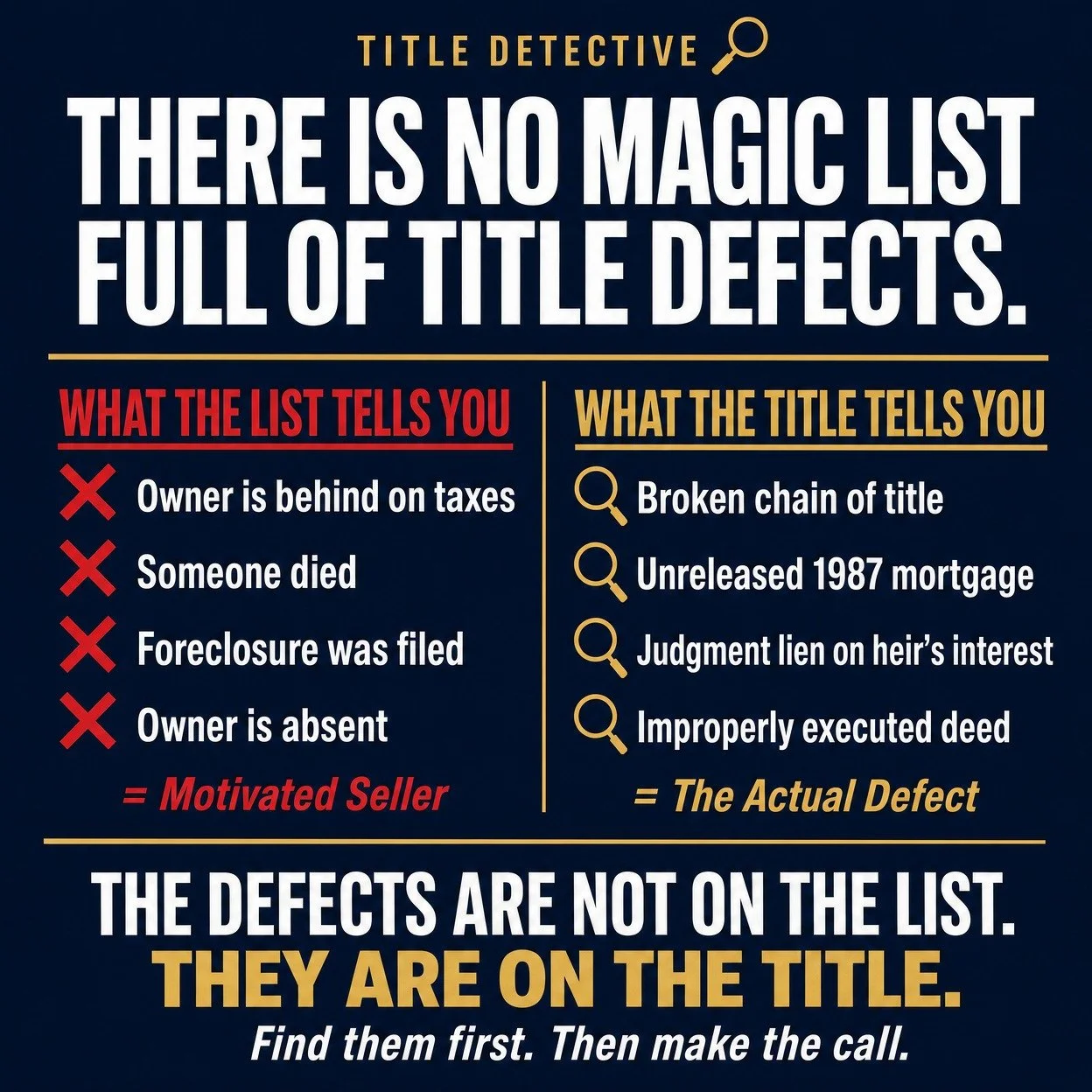
Every investor has a due diligence checklist. It usually involves running comps, estimating repairs, and calculating cash flow. But if your checklist doesn’t start with title, it’s incomplete.
This is the ultimate guide to a better due diligence process—one that puts title first.
The Title-First Due Diligence Checklist:
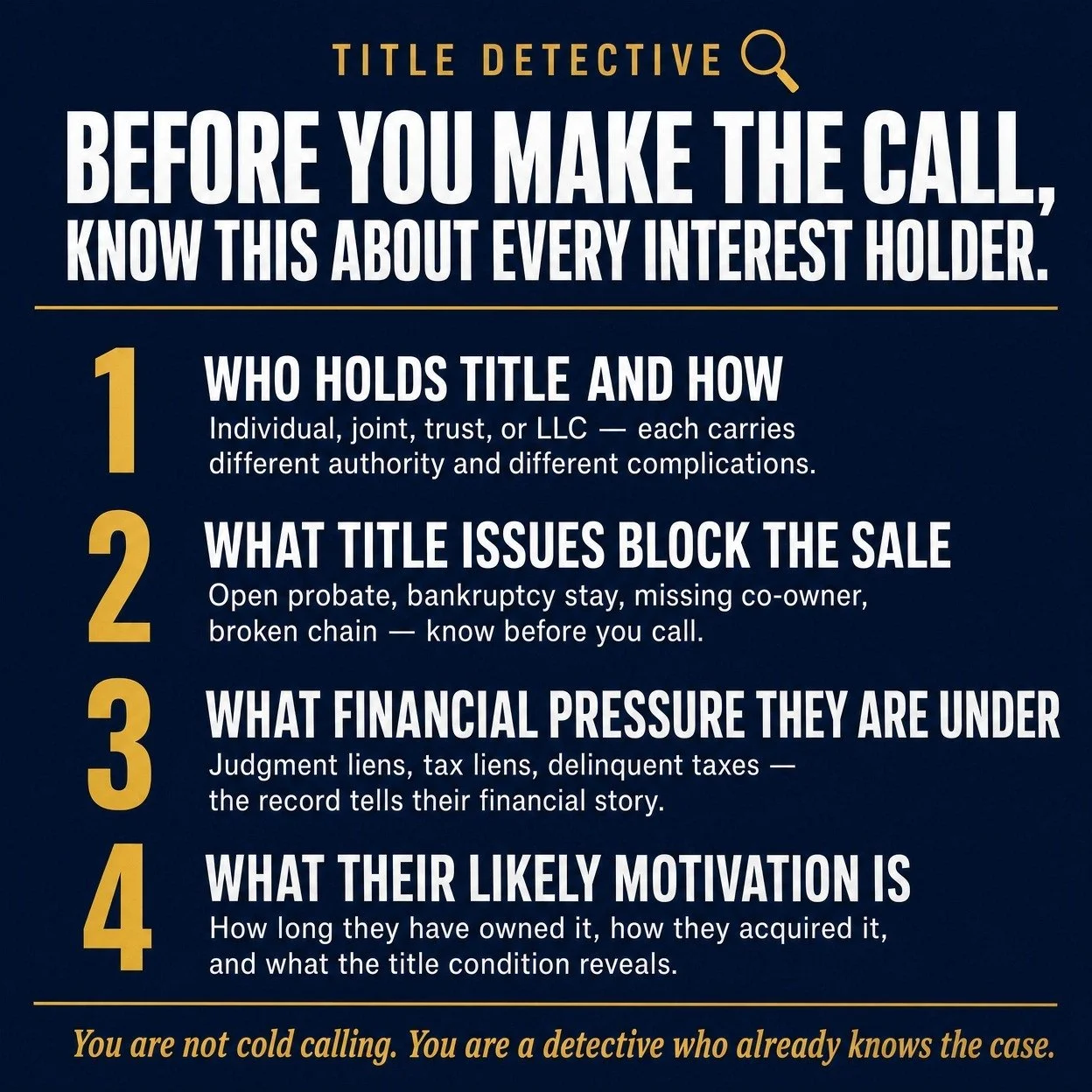
Verify Ownership: Who is on the last recorded deed? Does it match the person you’re talking to?
Check for Liens & Mortgages: Are there active mortgages, judgments, or tax liens against the property or the owner?
Analyze the Seller’s Story: Use the financial data (loan amounts, purchase date) to understand the seller’s situation. Is there equity? Are they in distress?
Review the Legal Description: Does the property described legally match what you see on the ground? Are there any easements or encroachments?
Assess Deal Viability: Based on the title, is this deal straightforward, complex, or a non-starter?
Only after you’ve completed this initial title investigation should you move on to the traditional financial analysis. This process saves you countless hours by weeding out the dead-end deals from the start.
This checklist is just the beginning. For a complete, in-depth system with sample documents, case studies, and advanced strategies, you need The Title Detective’s Playbook. It’s the most comprehensive guide to real estate due diligence ever written. [Buy your copy now and make every deal a sure thing.]






Investing in Probate Real Estate: A Guide to Title-First Due Diligence
Probate real estate offers huge opportunities, but also huge risks. Learn how to use a title-first approach to navigate the complexities of probate investing safely.
Probate real estate—properties being sold out of a deceased person’s estate—can be a goldmine for investors. These are often highly motivated sellers with properties that need a quick, no-nonsense sale. But they are also fraught with legal complexity.
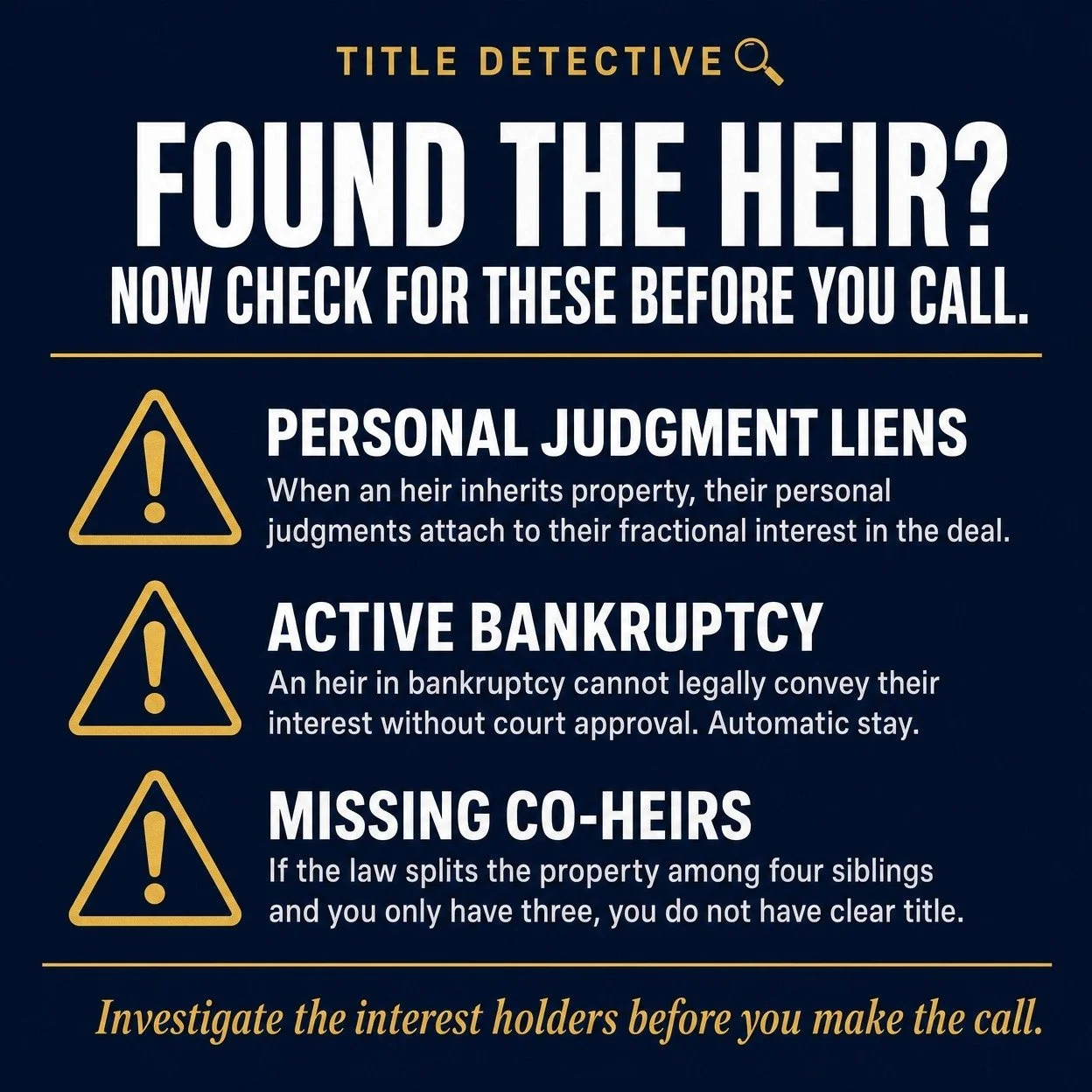
Investing in probate without a deep understanding of the title is a high-stakes gamble. You must answer critical questions before you even think about making an offer:
Who is the Personal Representative? Have they been legally appointed by the court with the authority to sell the property?
Are there other heirs? Do they all agree to the sale? A single dissenting heir has to be approached differently.
Are there estate debts? The property may be subject to claims from creditors, including the IRS.
The TIP Method is perfectly suited for probate investing. It helps you map out the entire legal and financial landscape of the estate, giving you a clear picture of the risks and opportunities. This knowledge allows you to solve problems for the estate, build rapport with the representative, and structure an offer that works for everyone.
Probate is not for beginners, but with the right training, it can be incredibly lucrative. The Title Detective’s Playbook provides a detailed checklist for probate due diligence.

“The Title Company Will Catch It” and Other Dangerous Real Estate Myths
Relying solely on the title company is a huge mistake. Learn the common myths about title searches and why you must conduct your own pre-deal investigation.
“Don’t worry, the title company will catch it.” It’s one of the most common—and most dangerous—myths in real estate investing.
While title companies are an essential part of the closing process, relying on them for your due diligence is a recipe for disaster. Here’s why:
• They Work at the End: The title company performs its search at the end of the transaction. If they find a problem then, you’ve already wasted weeks or months.
• They Are Not Your Investigator: Their job is to identify risks for the insurance underwriter, not to find creative solutions or negotiation leverage for you.
• Mistakes Happen: Title examiners are human, and indexing systems can be flawed. Issues can be missed, and the consequences can be catastrophic.
The smart investor treats the title company as a final verification step, not as their primary line of defense. You are your own best advocate. By learning the fundamentals of a title search and running your own TIP Report upfront, you take control of the process.
Don’t delegate your due diligence. Empower yourself with the knowledge to protect your own investments. The Title Detective’s Playbook teaches you what to look for, what questions to ask, and how to spot the red flags the title company might miss. [Order your copy and become your own best defense.]

How to Find the Real Owner of a Property (3 Detective Tricks)
Can’t find the owner of a vacant property? Learn three simple, effective methods for finding the true owner of any property, a crucial first step in off-market deals.
You’ve found the perfect property—a vacant house with untapped potential. There’s just one problem: you have no idea who owns it. Before you can craft an offer, you need to find the owner. This is a fundamental skill for any off-market investor.
Here are three detective tricks you can use:
Start with the County Tax Assessor: Every county maintains a public record of a property’s interest holder(s) for tax purposes. A simple online search on the county assessor’s website can often give you a partial legal description- a perfect starting point at the Recorder’s Office.
Become a Digital Detective: If the records held by the county are a dead end (e.g., a deceased person or an old address), go online. Don’t forget about the most powerful search engine-Google.
Talk to the Neighbors: Never underestimate the power of old-fashioned fieldwork. Neighbors are often a goldmine of information. They might know the owner’s name, their situation, or even how to get in touch with them.
Finding the owner is just the first step. The real work begins when you analyze the title to understand their story and motivation. The TIP Method is your guide to this deeper level of due diligence.
Mastering the art of finding owners is a superpower. The Title Detective’s Playbook dedicates an entire chapter to advanced skip-tracing and owner research techniques. [Get your copy to become a master at finding off-market deals.]

What is a "Cloud on Title"? A Real Estate Investor's Guide
A cloud on title can kill your deal. Learn what causes a clouded title, how to spot one before you invest, and how to turn these “problems” into profit.
It’s the phrase that makes every investor’s blood run cold: “There’s a cloud on the title.”
A “cloud on title” is any issue, claim, or lien that makes the legal ownership of a property uncertain. It’s a ghost in the machine that can derail your transaction, lock up your capital, and turn a promising deal into a legal nightmare.
Common causes include:
• An unreleased mortgage from a previous owner.
• A contractor’s lien for unpaid work.
• A boundary dispute with a neighbor.
• A break in the chain of ownership (e.g., a missing heir).
Most investors only discover these clouds during the final title search, long after they’ve invested time and money into the deal. But a Title Detective knows that clouds aren’t just problems; they’re signals. A cloud is a sign of a motivated seller and an opportunity to create value where others only see risk.
The key is to find these clouds before you make an offer. The TIP Method teaches you how to run your own preliminary title investigation to spot these issues from a mile away. When you control the information, you control the negotiation.
Don’t let a cloud on title rain on your parade. Learn to spot them, solve them, and profit from them. The Title Detective’s Playbook shows you how, step-by-step. [Buy the book and learn to turn title clouds into cash flow.]

Stop Gambling: Why the "Title-First" Approach is the Future of Real Estate Investing
The standard way of analyzing real estate is flawed. Learn why successful investors are adopting a “title-first” approach to reduce risk and find hidden deals.
For decades, a single, flawed philosophy has dominated real estate education: find a property, run the numbers, make an offer, and let the title company handle the rest. This is not a strategy; it’s a gamble. It’s the root cause of deals collapsing at the last minute and investors wasting fortunes on dead ends.
It’s time for a revolution. It’s time for title-first investing.
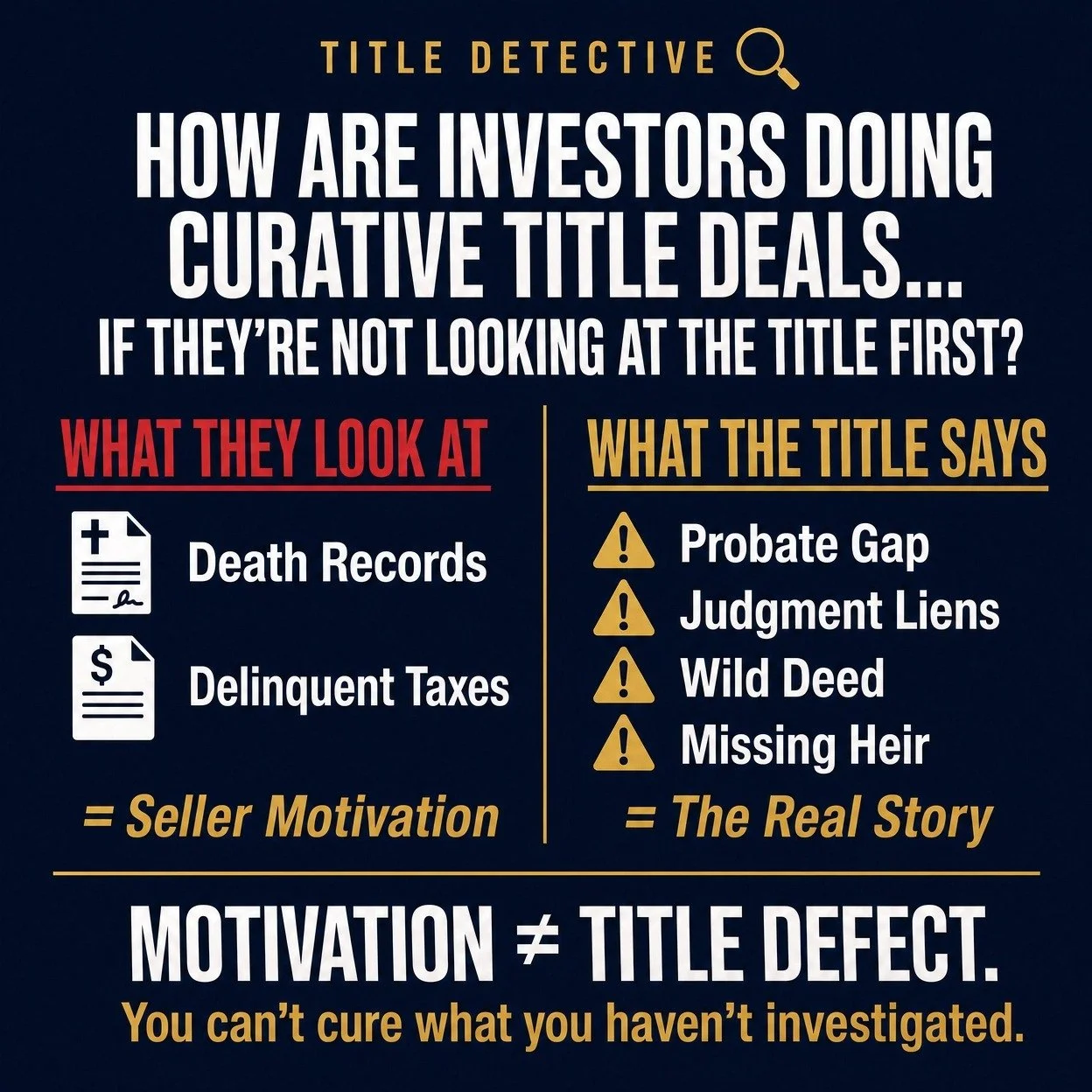
Title-first investing is a paradigm shift. It’s the radical idea that your due diligence shouldn’t start with a spreadsheet, but with a story—the story of the property’s title. Before you calculate a single number, you must answer fundamental questions: Who has the legal right to sell? What hidden financial claims are attached to this property? What is the human story behind the sale?
Answering these questions upfront doesn’t just prevent disasters; it uncovers opportunities. A messy title that scares away your competition could be your most profitable deal, but only if you know about it from day one.
This is the core philosophy behind the TIP Method (Title Intelligence Profile). It’s about moving from a reactive, hopeful investor to a proactive, strategic detective.
In this new era of real estate, the investors who win will be the ones who see the full picture. They will be the ones who investigate first and invest second.
Ready to join the revolution? The Title Detective’s Playbook is your guide to mastering the title-first approach.

The $30,000 Handshake: How a Partial Interest Deal Became a Title Nightmare
An investor spent thousands on a partial interest deal, only to be blindsided by a title issue. Learn how a title-first approach prevents this costly mistake.
I hear stories like this every week. An eager investor finds what looks like a golden opportunity—a partial interest in a promising property. They talk to the interest holders, agree with some on a price, and wire tens of thousands of dollars. The deal feels done. They have an established interest.
Then, weeks or months later, the other shoe drops.
A title search, conducted far too late in the process, reveals a tangled web of liens, judgments, or heirship claims. The investor, who thought they had secured a valuable asset, now owns a piece of a legal and financial nightmare. They’ve overpaid for a problem they didn’t know existed, and their path to profit is blocked by a mountain of legal fees and reactive cleanup.
This isn’t just bad luck; it’s the predictable result of a flawed process. It’s what happens when you put the deal before the due diligence.
The Reactive Investor vs. The Proactive Detective
The standard approach to real estate, especially in the fast-paced world of off-market deals, is to focus on the numbers and the negotiation first. The title search is often treated as a final checkbox, a formality before closing. This is a reactive stance, and it’s incredibly risky.
The proactive investor—the Title Detective—flips the script. Before a single dollar is discussed, before a handshake is made, they investigate.
This is where the TIP Method (Title Intelligence Profile) becomes your secret weapon. A TIP report is a comprehensive analysis you conduct before you ever talk to the seller. It’s your chance to see the full story, not just the one the seller wants to tell you.
What Could a TIP Report Have Revealed?
In the case of our unfortunate partial interest investor, a 15-minute TIP report could have revealed:
The True Ownership Structure: Was the seller the only person with a claim to the property? Were there other heirs or partners with conflicting interests?
Hidden Liens & Judgments: Were there outstanding debts attached to the property that would eat into any potential profit? (e.g., IRS liens, Medicaid liens, judgments).
The Seller’s Motivation: A financial profile might have shown the seller was under immense pressure, giving the investor significant leverage to craft a much better, more informed offer.
Instead of overpaying for a problem, the investor could have walked away, or better yet, used that information to structure a creative deal that solved the seller’s problem and created a massive win for themselves.
Stop Being Reactive. Start Being Proactive.
Your capital is too valuable to risk on incomplete information. Signing documents and wiring funds before you have a clear picture of the title is not investing; it’s gambling.
By utilizing a TIP report before talking to anyone, you shift from being a reactive victim of circumstance to a proactive dealmaker who controls the narrative. You know what issues lie ahead and can plan for them, turning potential disasters into your most profitable ventures.
Ready to stop guessing and start investigating? My book, The Title Detective’s Playbook, gives you the complete step-by-step guide to implementing the TIP Method and protecting your investments. Get your copy today and learn how to see the deals no one else can.

Keeping a House that's Always Show Ready
Selling your home? Need Tips for Keeping Your House ‘Show Ready?’
Tips for Keeping a Clean Home when Selling
Keeping a clean home can be a challenge-even when you do not have your home listed for sale. Some are fortunate enough to have regular house cleaners take care of this. For the rest of us, we have to find time in our week to take care of our home ourselves.

Experts suggest creating a schedule to accomplish important tasks each week is the best way to keep a clean home without the stress. Taking into account that things change, customize a schedule/list to fit your own weekly activities.
Below is an example. By using this plan, you could keep your home clean all week, with only 5 days of effort.
Day 1 - Dust and then vacuum the home. Dust first as the dust will fall onto the floor. Mop any hard surface floors as well.
Day 2 – Deep clean bathrooms, shower and toilets, clean mirrors and shine fixtures.
Day 3 – Address the kitchen. Check the inside of the microwave, oven and clean drips off of cabinets.
Day 4 – Window day. Clean all the windows you can reach. Hire a professional if needed.
Day 5 – Garden work. Trim trees, remove weeds and remove debris.
I have clients that tell me their biggest trick to keeping a tidy home is doing a small load of laundry every night-that includes washing, drying, folding and putting away (do people really do that-ALL in the same day?!), and cleaning one room at a time, per day, in addition to the daily dishes and clutter.
Keeping up with kids?

Sometimes trying to keep a clean house can feel defeating when your kiddos are making messes as fast as you can clean them (or at least that’s how it can seem!) To help them think about how they can help Mom and Dad, have a conversation with them about why it is important to keep things picked up and give them age appropriate chores around the house so they can help. If you are worried about the chemicals they may be coming in to contact with, there are lots of great, natural cleaners on the market, and Pinterest has a TON of recipes for natural cleaners you can whip up yourself!
I have gotten my kids involved in household chores, and have found that laminated cards with each room/chore and a description of what your expectation is, helps tremendously in insuring they understand what you mean when you say “Clean the bathroom.”
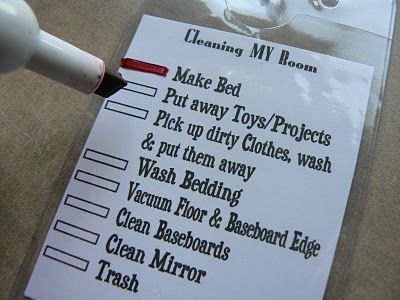
Cards can even be a great reminder for adults that get distracted while cleaning! (I’m the worst about starting in one room, taking something in another room, then starting a new cleaning project in that other room…)
Seeing a card that breaks down each step helps them to know exactly what cleaning each room entails. Depending on their age and skill level, you could break steps down farther (Clean Toilet: spray with cleaner, wipe tank lid and flush handle, wipe tank, wipe seat lid, then seat, under seat, use scrub brush to clean inside bowl, wipe where seat attaches to toilet and around the rim, clean outside of bowl, sides, around bolt covers and the floor) and have multiple cards for each room, connected with a ring.
Having your kids help with household chores helps them to develop independence, respect, responsibility, a good work ethic, self reliance and an ability to plan (thinking to the next step, what supplies do I need to do this job, etc.) which will be beneficial throughout their life. It also helps you get more accomplished in one day!
Sounds easy, right? No. Life is hectic and it’s hard to carve out time during the week, but breaking the work into smaller chunks and enlisting the help of your spouse and children can make it less burdensome. Of course, throughout the week, check for basic maintenance; countertops, kitchen spills and pet hair, etc. The great thing is, there isn’t one schedule for cleaning. Find one that works for you and that will be easy for you to stick to! These schedules are a framework you can use to create your own plan and make sure your home is always clean and show-ready!


Audra George is a licensed Realtor in Missouri, and is the Broker for The Realty Company. Audra has a diverse background; she is a former middle school Math teacher and holds a Bachelor’s Degree in Education, she worked with survivors after the May, 2011 tornado in Joplin, Missouri, and has extensive experience in online marketing- previously running marketing campaigns for fundraising companies, including creating marketing plans for retail and online businesses. Audra has received numerous awards for her work, including her work with individuals after the tornado, and 'Rookie of the Year' in her first year of Real Estate sales, and ‘Salesperson of the Year’ each year after.
Audra lives in Southwest Missouri with her two boys, two dogs, kangaroos, squirrel and cats. Audra works hard for her clients to make the process of selling and purchasing property as easy as possible.
Are you thinking of selling your home? If so, I’d like to talk to you about other tips and tricks to sell your home fast! If you get tired of trying to sell on your own, I’d love the opportunity to interview for the job! I will explain how I MARKET your home, sell it faster, and for the highest price!
Call or text for an appointment today! -Audra George, The Realty Company (417) 850-7220 or Contact Me

Realtor Says, "Don't LIST Your Home!"
Know these three things!
That’s right! A Realtor is telling you NOT to list your home with a Realtor. Why? You want to get top dollar for the sale of your most valuable asset by enlisting the help of a professional. Is it really worth the cost of commission if they just put it on the MLS and let it sit, hoping to get some calls, letting other agents do all the work? Any agent can list a home on the Multi-Listing Service (MLS). That’s the easy part. The person you choose to put their sign in front of your home should be MARKETING it, not just listing it.
So, how do you know what your prospective agent is going to do for you?
Ask questions (a lot of them). The Realtor you are interviewing should be willing to answer any questions regarding the listing process/marketing of your home, and about their career in real estate. Still not sure what questions to ask?
How long have you been selling real estate? How do you plan to market this house? Where are you going to market it? Do you have your own website? How frequently do you refresh your ads based on the results they are getting? How do you let other agents know my house is on the market? How soon are you going to do an open house? Is there anything you would recommend I should do to make my house sell faster? What is the average amount of time from the date you list a house to it being under contract? What quality of camera do you use when taking photos of a house? How will you be in contact with me?
Ask for examples. Ask the prospective agent to see current ads of their other listings running on Facebook, on their website, in the newspaper or local house marketing magazines, Google Ads, Twitter, Instagram, Pinterest… where-ever they say they are going to market your home.
Ask for references. It’s ok to ask for references. Talk to other sellers (former and current) and see what they have to say. If you call for a consultation with a Realtor, that does not bind you to work with them. Find out if they call back in a reasonable time frame, and if they were able to answer all the questions the other sellers had. If they didn’t know the answer immediately, was the agent able to find it and get back to them quickly? How frequently did they reach out to the sellers?
There are hundreds of Realtors in any given area. They are not all the same! Selling your home can become an involved process, and you should interview several Realtors until you find one that you feel you can work with comfortably, that will represent you the way you want. By following the three suggestions above, you will have a much higher probability of selecting a top producing Realtor, willing to MARKET your home, not just LIST it!
Are you thinking of selling your home? If so, I would love the opportunity to interview for the job! I would be happy to explain how I will MARKET your home, sell it faster, and for the highest price! Give me a call or text today! -Audra George, The Realty Company (417) 850-7220 or Contact Me